

Sustainability
Our Approach to Environmentally Conscious Design
- Basic Approach
- Long-life Design
- Energy-saving Design
- Resource-saving Design
- Office-friendly Design
- Life Cycle Assessment
Basic Approach
Environmentally Conscious Design Initiatives
Our products are based on long-life designs that reduce part replacement and disposal. By incorporating the principles of reduce, reuse, and recycle (3R), we promote effective resource use and waste reduction.
Low-power designs reduce energy consumption and help lower environmental impact by curbing greenhouse gas emissions.
We also ensure product safety and promote designs that minimize impacts on people and the environment by restricting and managing hazardous substances.
Conducting Environmental Assessment
From the initial stages of new product development, we design products in accordance with our Environmentally Conscious Design Standards. During design, we set targets for the following items:
| ・ | Longer service life of parts |
| ・ | Reduced power consumption |
| ・ | Fewer parts and lower product weight |
| ・ | Increased use of recycled materials |
| ・ | Easier disassembly and material separation for recycling |
| ・ | Restriction and management of hazardous substances |
In material selection, we promote the use of recycled and environmentally certified materials to achieve sustainable resource use.
Six Environmental Assessment Criteria
Based on the design policy above, we assess products against the following criteria and promote the development of environmentally conscious products.
| Item | Description |
|---|---|
| Long-life design | Enables long-term product use by improving part durability and reducing replacement frequency. |
| Resource- and energy-saving design | Reduces resource use and energy consumption to lower environmental impact. |
| 3R design (Reduce, Reuse, Recycle) | Promotes effective resource use and waste reduction. |
| Design for easy disassembly, separation, and sorting | Uses structures that facilitate disassembly and material separation during recycling. |
| Management of hazardous substancesUse of low-environmental-impact materials | Restricts chemical use and manages substances appropriately in accordance with applicable laws to minimize impacts on people and the environment. |
| Use of low-environmental-impact materials | Promotes the active use of sustainable resources, including recycled and environmentally certified materials. |
Through design based on these criteria, we continuously pursue environmental initiatives not only in product development, but also in product packaging and logistics.
Long-life Design
Long-life design is a core technology that underpins Kyocera Document Solutions' environmentally conscious product development.
By enhancing the durability of key components, we reduce the need for part replacements and minimize waste generation, contributing to lower resource consumption, reduced CO₂ emissions, and optimized total cost of ownership (TCO*1).
Here we introduce some of the key technologies that make our long-life design possible.
*1 TCO (Total Cost of Ownership): The total cost incurred throughout a product's lifecycle, including acquisition, operation, maintenance, and disposal.
Development of Long-Life a-Si Photoconductor Drums
At the core of the ECOSYS concept, the a-Si (amorphous silicon) photoconductor drum uses a highly durable a-C (amorphous carbon)-based thin film with near-diamond hardness as its protective surface layer, achieving a service life of more than one million pages.
A submicron-scale textured pattern is formed on the outermost drum surface, reducing friction with the cleaning blade by approximately 30%. This extends peripheral-device life and achieves an industry-leading*2 photoconductor-unit life of 600,000 pages for a 30 mm-diameter drum.
Reduced friction also cuts photoconductor-drum drive power by 30%, contributing substantially to lower CO₂ emissions.
The fast photosensitivity of a-Si photoconductors enables use in high-speed engines, while the sharp electrostatic latent images formed by laser light support high-definition imaging.
*2 Based on our research as of May 2026.
 Long-life a-Si Photoconductor Drum
 Structure of the Long-life a-Si Photoconductor Drum
Development of Long-Life PSLP Organic Photoconductor Drums
In addition to conventional organic photoconductors (OPC), we commercialize positively charged single-layer organic photoconductor drums (PSLP*3) for MFPs and printers.
Unlike conventional negatively charged multilayer OPC drums, whose photoconductor characteristics can become unbalanced as the surface wears, the single-layer PSLP structure maintains a stable balance and performance over long periods even as wear progresses.
Combining this drum with our proprietary long-life technologies delivers more than ten times the service life of conventional OPC drums.
Because PSLP drums have a much simpler manufacturing process than conventional OPC drums, manufacturing energy can be reduced to approximately one-third of that required for a comparable conventional OPC drum. This also substantially reduces CO₂ emissions during manufacturing.
*3 Positive-charged Single Layer Photoconductor
 Structure of the PSLP Drum
Extending Printhead Service Life
For inkjet printers, effectively removing dried ink and contamination from the printhead surface is essential to maintaining high print quality.
The TASKalfa Pro 15000c uses a proprietary cleaning fluid that dissolves dried ink. Fluid is supplied from a dedicated nozzle at the end of the head, and a rubber blade wipes the head surface to remove adhered ink and contamination.
A finishing rinse with cleaning fluid and a blade-cleaning mechanism provide high cleaning performance. As a result, stable print quality is maintained over long periods, enabling 60 million maintenance-free prints.
Reducing maintenance frequency also lowers waste-liquid generation and conserves water resources, helping reduce environmental impact.
These long-life printhead technologies and proprietary ink received the Imaging Society of Japan Technology Award for FY2021 in recognition of their technical advancement and sustainability.
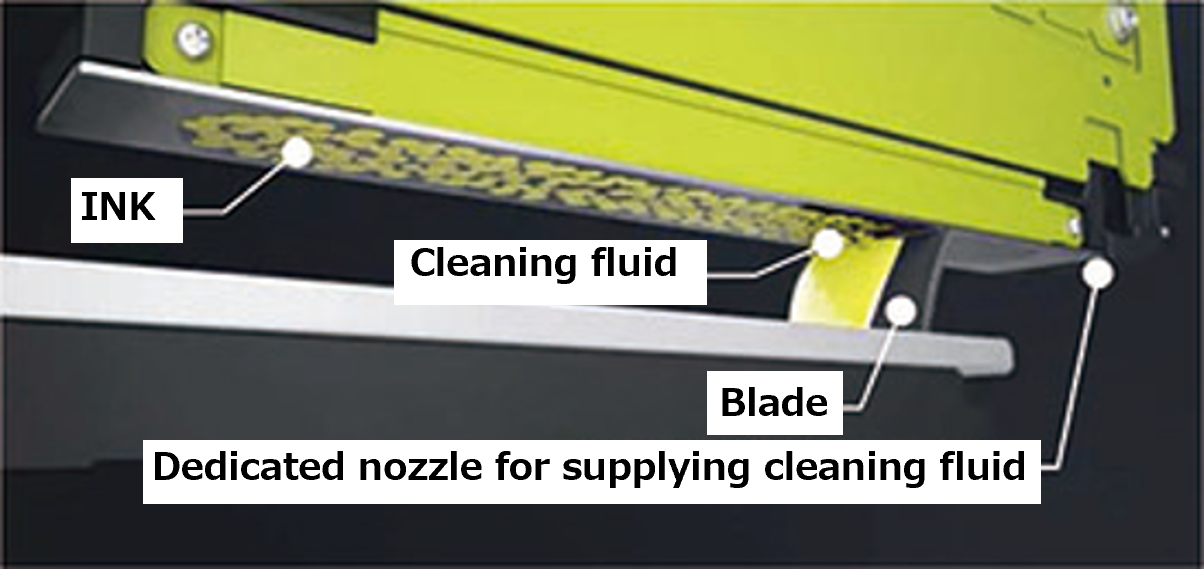 Illustration of Printhead Cleaning
Energy-saving Design
In our MFPs, printers, and commercial inkjet production printers, a large share of electricity is consumed as standby power for functions such as fax standby and LAN connectivity, and as power used to fix toner or ink onto paper during printing.
To reduce this electricity consumption, we develop and incorporate a range of technologies that improve product energy efficiency.
Development of Toner Using a New Manufacturing Method
Building on our established melt-kneading and pulverization process, we developed a new toner manufacturing technology. A thin shell layer is formed by a wet process on the surface of the core particles.
This proprietary technology substantially reduces toner viscosity and enables fixing at a temperature approximately 30°C lower than conventional toner. It significantly reduces energy consumption in the fixing process and contributes to energy savings.
Combined with highly energy-efficient fixing systems, this technology reduces environmental impact across a wide range of our products.
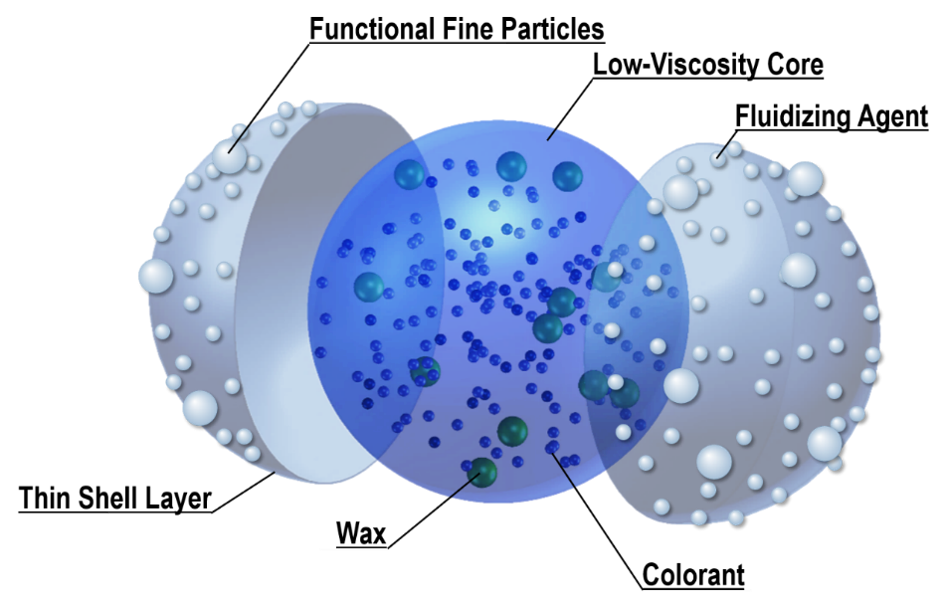 Conceptual Illustration of Toner Produced Using the New Method
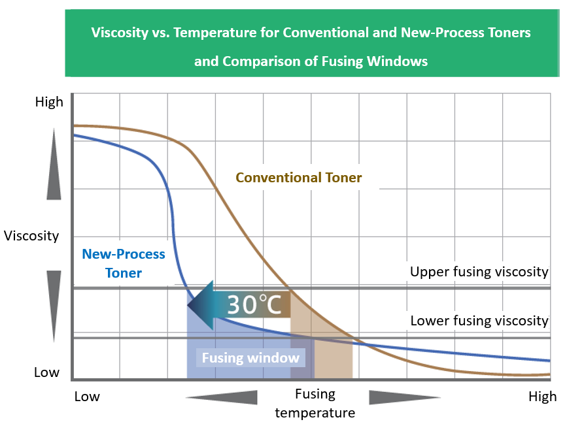 Comparison of Viscosity Changes and Fixable Temperature Ranges: Conventional and New-Method Toners
Development of Low-Power-Consumption Ink
The proprietary water-based pigment ink used in the TASKalfa Pro 15000c commercial inkjet production printer penetrates paper readily and dries quickly after printing, reducing the energy required to fix the ink onto the paper.
Careful material selection in this proprietary ink also reduces VOC (volatile organic compound) emissions during high-speed printing.
Analog commercial printing methods such as offset printing generally require exhaust ducts and VOC recovery or treatment equipment to comply with VOC emission standards.
By using proprietary ink with reduced VOC emissions even during high-volume printing, the TASKalfa Pro 15000c requires no VOC treatment equipment and helps reduce environmental impact.
Development of an Energy-saving Controller
As reductions in power consumption and CO₂ emissions become increasingly important, lowering standby power is a key issue for office MFPs and printers. Fast recovery from standby is also required without compromising usability or productivity.
Our energy-saving controller minimizes standby power consumption while enabling rapid recovery from standby.
MFPs and printers equipped with this controller achieve industry-leading standby power without compromising usability or productivity. Some products achieve standby power consumption as low as 0.3W.
 Newly Developed Energy-saving Controller
Development of an Energy-saving Planar Heater
The proprietary water-based pigment ink used in the TASKalfa Pro 15000c commercial inkjet production printer penetrates paper readily and dries quickly after printing, reducing the energy required to fix the ink onto the paper.
Careful material selection in this proprietary ink also reduces VOC (volatile organic compound) emissions during high-speed printing.
Analog commercial printing methods such as offset printing generally require exhaust ducts and VOC recovery or treatment equipment to comply with VOC emission standards.
By using proprietary ink with reduced VOC emissions even during high-volume printing, the TASKalfa Pro 15000c requires no VOC treatment equipment and helps reduce environmental impact.
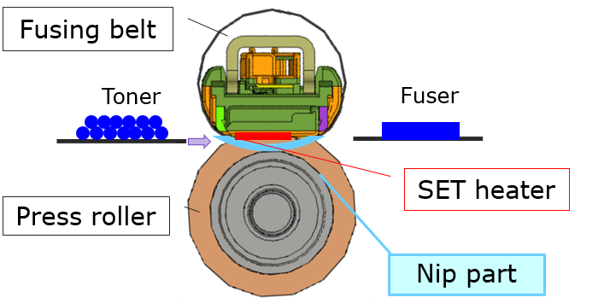
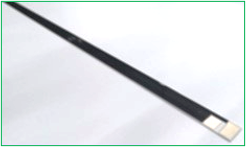 Planar Heater
Resource-saving Design
Reuse of Used Toner Containers
The TASKalfa 6052ci Series of A3 color MFPs, launched in July 2016, allows an empty black toner container to be reused as a waste toner container.
Previously, waste toner required a dedicated collection container that had to be replaced when full.
Reusing the empty toner container as the waste toner container reduces the number of parts and contributes to resource and cost savings.

Reduction in Sheet-Metal Use
Resource-Saving Design and Weight Reduction Using CAE
The frame of the ECOSYS M6535cidn A4 color MFP is made of sheet-metal parts. To reduce sheet-metal use and product weight, we use CAE*4 structural analysis to design an optimized frame shape while maintaining strength.
As a result, the product is approximately 20% lighter than the previous model.
The figure shows shape optimization using CAE structural analysis. Arrows indicate twisting direction, and colors indicate stress on the sheet metal. Red indicates higher stress and blue indicates lower stress.
Based on the analysis, high-stress areas were locally reinforced, for example by using thicker sheet metal, while low-stress areas were made as thin as possible. This reduced sheet-metal use while maintaining the required strength.
*4 Computer-Aided Engineering: Computer systems that support industrial product design and development.

Development of a Pipe-Frame Structure
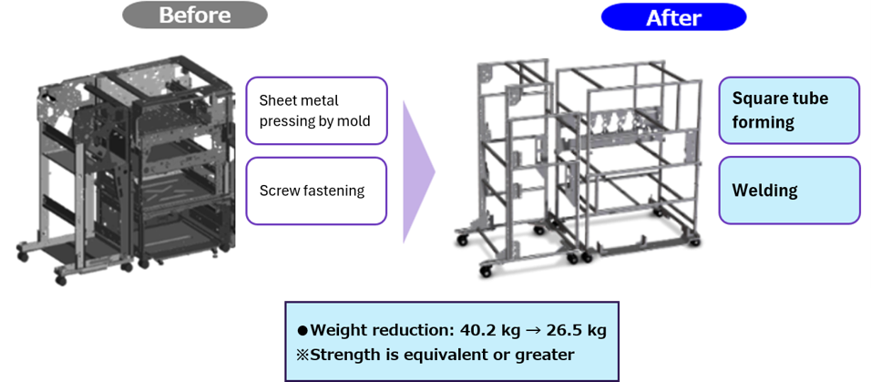
Conventional main-body frames were composed primarily of sheet-metal parts. We have introduced a new pipe-frame structure.
Replacing the sheet-metal-centered structure with a skeleton made of square pipes reduces sheet-metal use and frame weight while maintaining strength and rigidity. The lower overall product weight also reduces resource use and environmental impact during manufacturing.
The lighter weight also helps reduce energy consumption and CO₂ emissions during transportation.
Initiatives to Reduce Packaging Materials
We are reducing plastic in packaging and actively use molded pulp made from recycled wastepaper in addition to corrugated cardboard.
We also optimize cushioning structures and shapes to reduce packaging materials, improve transport efficiency, and make packaging lighter and more compact.
For example, by changing from all-corrugated cushioning to a structure using molded pulp for cushioning and corrugated cardboard for retention, we reduced cushioning material use by 72%.
We are also developing packaging technology that minimizes degradation in cushioning performance caused by repeated impacts, a challenge for paper cushioning materials.
These initiatives have earned our packaging designs multiple awards in the Japan Packaging Contest and the World Star Awards.
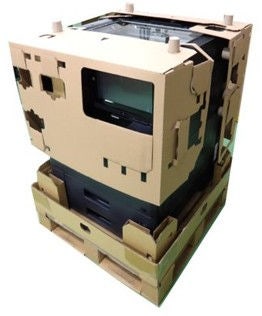 Packaging recognized in the 2025 Japan Packaging Contest
Use of Recycled PET in Container Bottles
We were the first in the industry to establish technology that recycles waste PET film from multilayer ceramic chip capacitor production and upcycles it into parts for MFPs and printers.
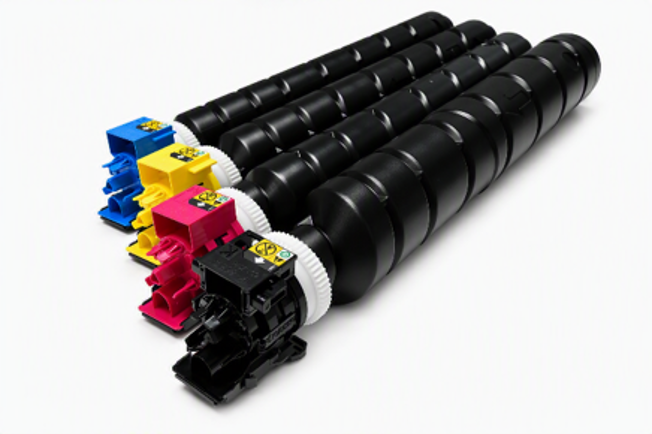
As shown, the recycled PET is used for resin parts such as toner containers, achieving 62% recycled-material content in the resin parts of toner containers.
Using waste PET film that was previously incinerated promotes resource circulation and reduces CO₂ emissions associated with incineration.
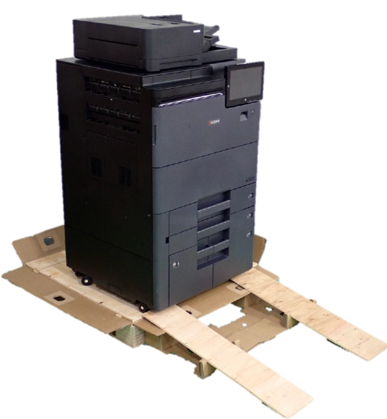
Reduction in Wood Use (Elimination of Wooden Ramp Components)
A dedicated 3.5 kg wooden unpacking ramp was replaced by a design that uses parts of the packaging and pallet structure. This maintains unloading functionality while reducing resource use, product weight, and material consumption.
Eliminating storage space for the dedicated ramp also reduced packaging volume by approximately 16% versus the previous design, improving transport efficiency and reducing environmental impact.
Office-friendly Design
In addition to resource and energy conservation, creating a comfortable office environment is an important design theme. Our MFPs and printers feature space-saving designs, low-noise operation, and quiet modes for use in quiet environments.
Low-Noise Design
We work to reduce product noise to create comfortable office environments.
Optimized Fan Layout
In the ECOSYS MA2600cwfx A4 color MFP, the placement of heat-generating parts and internal airflow are optimized for efficient cooling.
Revising the internal airflow design reduced the number of cooling fans from four in the previous model to one, lowering fan noise, saving energy, and reducing the number of parts.
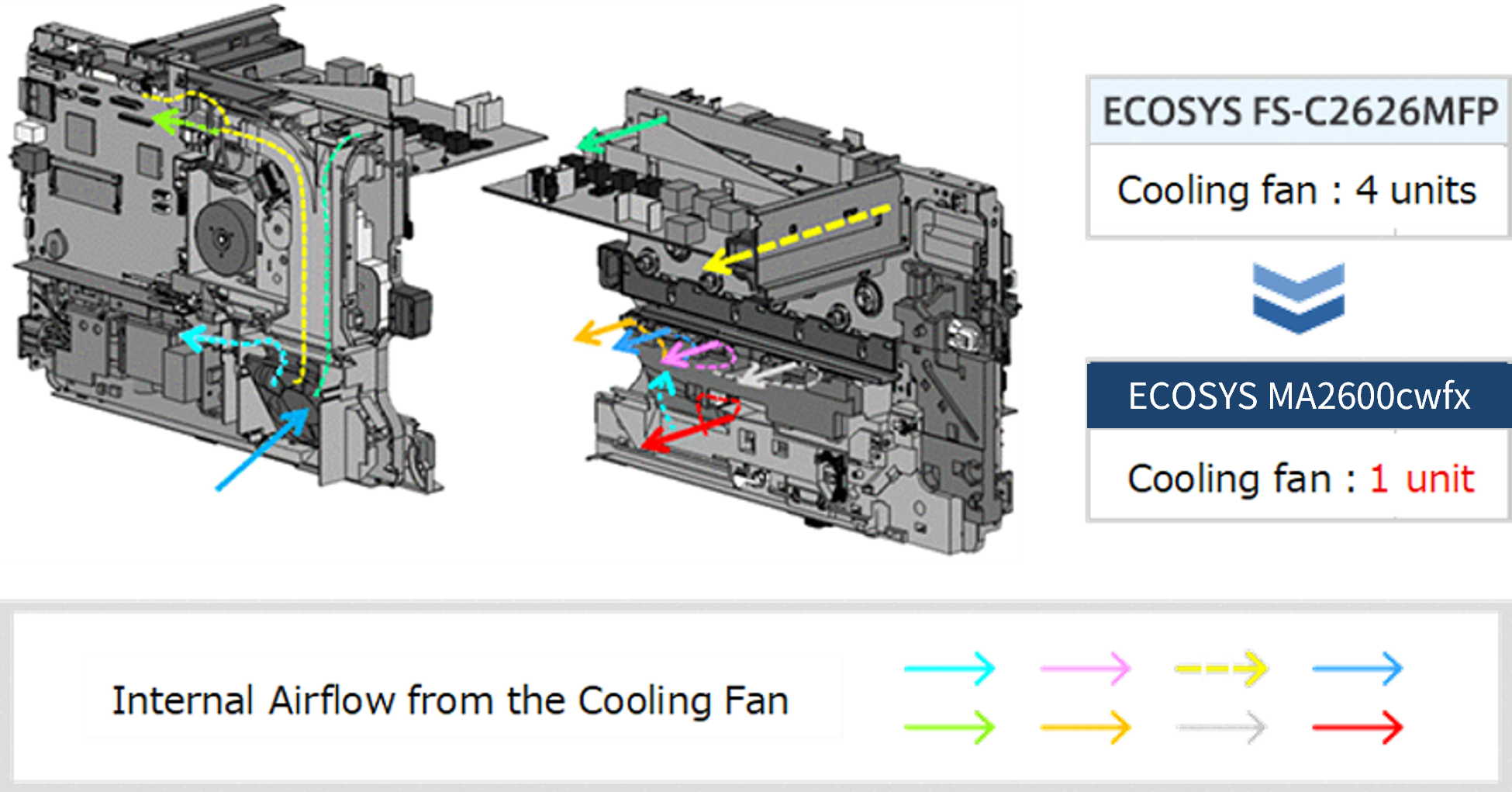 Airflow Inside the ECOSYS MA2600cwfx
Water-Cooling System
To suppress toner degradation and maintain stable image quality, we use a water-cooling system for the developing units.
The system consists of a coolant tank, heat exchanger, radiator, pump, and piping. Coolant circulates inside the machine to dissipate heat efficiently from the developing units.
This suppresses temperature increases in the developing units and ensures stable image formation during continuous printing.
Water cooling also reduced the number of developing-unit cooling fans from eight to three, lowering operating noise and contributing to a more comfortable office environment.
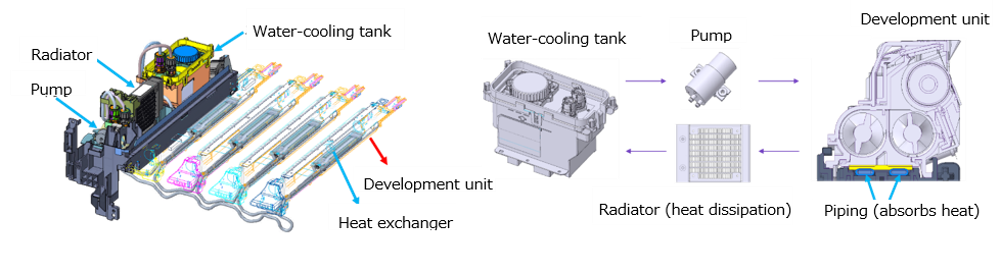 Water-Cooling System for Developing Units
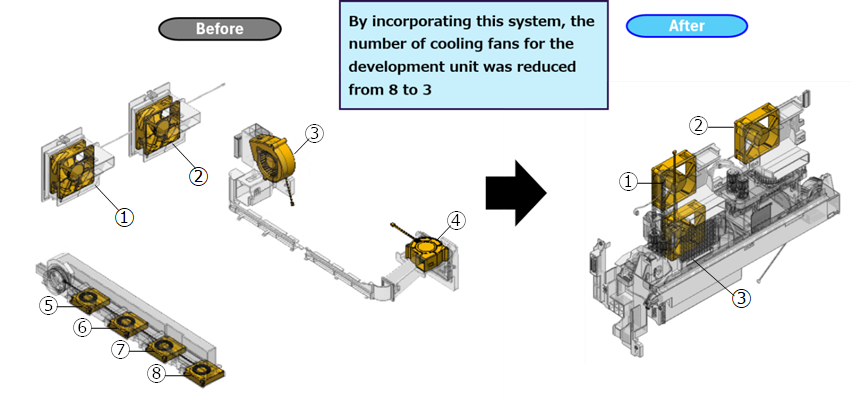 Cooling Fans
Reduction in Main-Unit Drive Motors
In the ECOSYS MA2600cwfx A4 color MFP, thorough torque reduction in the process and paper-feed transport units enables operation with fewer motors.
By consolidating imaging-system and transport-system drives, the number of main-unit drive motors was reduced to two: one imaging drive motor and one transport drive motor.
Compared with the previous model, the design reduces motor count, operating noise, and the number of parts.
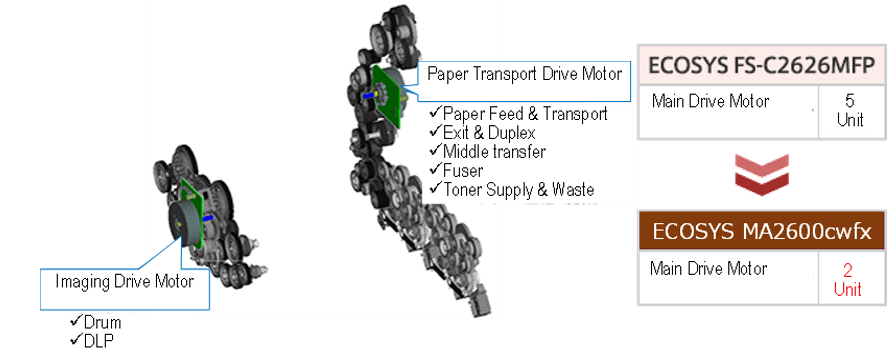 Reduction in Main-Unit Drive Motors
Comparison of Noise Levels
| Model | Previous model | New model | Reduction |
|---|---|---|---|
| Color A4 MFP ECOSYS FS-C2626MFP | Color A4 MFP ECOSYS MA2600cwfx | ||
| Sound Pressure Level | 50.0 dB | 49.0 dB | x0.89 |
| Sound Power Level | 61.7 dB | 60.1 dB | x0.69 |
Quiet Mode
Our A4 color MFPs and printers include a Quiet Mode that suppresses operating noise.
Depending on the usage environment, users can select Quiet Mode continuously or apply it on a job-by-job basis, enabling flexible operation.
Quiet Mode reduces operating noise to 45–47 dB*5, supporting comfortable use in quiet offices and shared spaces.
*5 40 dB is equivalent to the noise level of typical city street at midnight or inside a library, while 50 dB is about the same as a quiet office.
Comparison of Noise Levels
| Model | Noise level | |
|---|---|---|
| Normal mode | Quiet Mode | |
| ECOSYS MA2600cwfx/PA2600cwx | 49 dB | 44 dB |
| ECOSYS MA3500cifx/PA3500cx | 51 dB | 47 dB |
| TASKalfa MA3500ci | 51 dB | 47 dB |
| ECOSYS PA4500cx | 54 dB | 50 dB |
Compact Design
Compact Main Unit
The ECOSYS MA3500cifx A4 color MFP and ECOSYS PA3500cx A4 color printer, launched in September 2023, achieve a lower profile through smaller units and an optimized layout.
Key measures include a lower scanner using a CIS module, a smaller laser scanning optical system using a short-focus fθ lens, a shorter paper path through high-precision transport-speed control, and a smaller output unit with improved cooling.
These technologies reduce machine height versus the previous model and improve installation flexibility. They also improve control-panel visibility and make it easier to load and remove originals at desktop height.

| Unaddressed model | Addressed model | Effect | |
|---|---|---|---|
| Color A4 MFP ECOSYS M6635cidn | Color A4 MFP ECOSYS MA3500cifx | ||
| Total Height [mm] | 620 | 575 | 7.2% reduction |
| Volume [L] | 171.71 | 159.39 | 7.1% reduction |
Compact Enhancement Devices
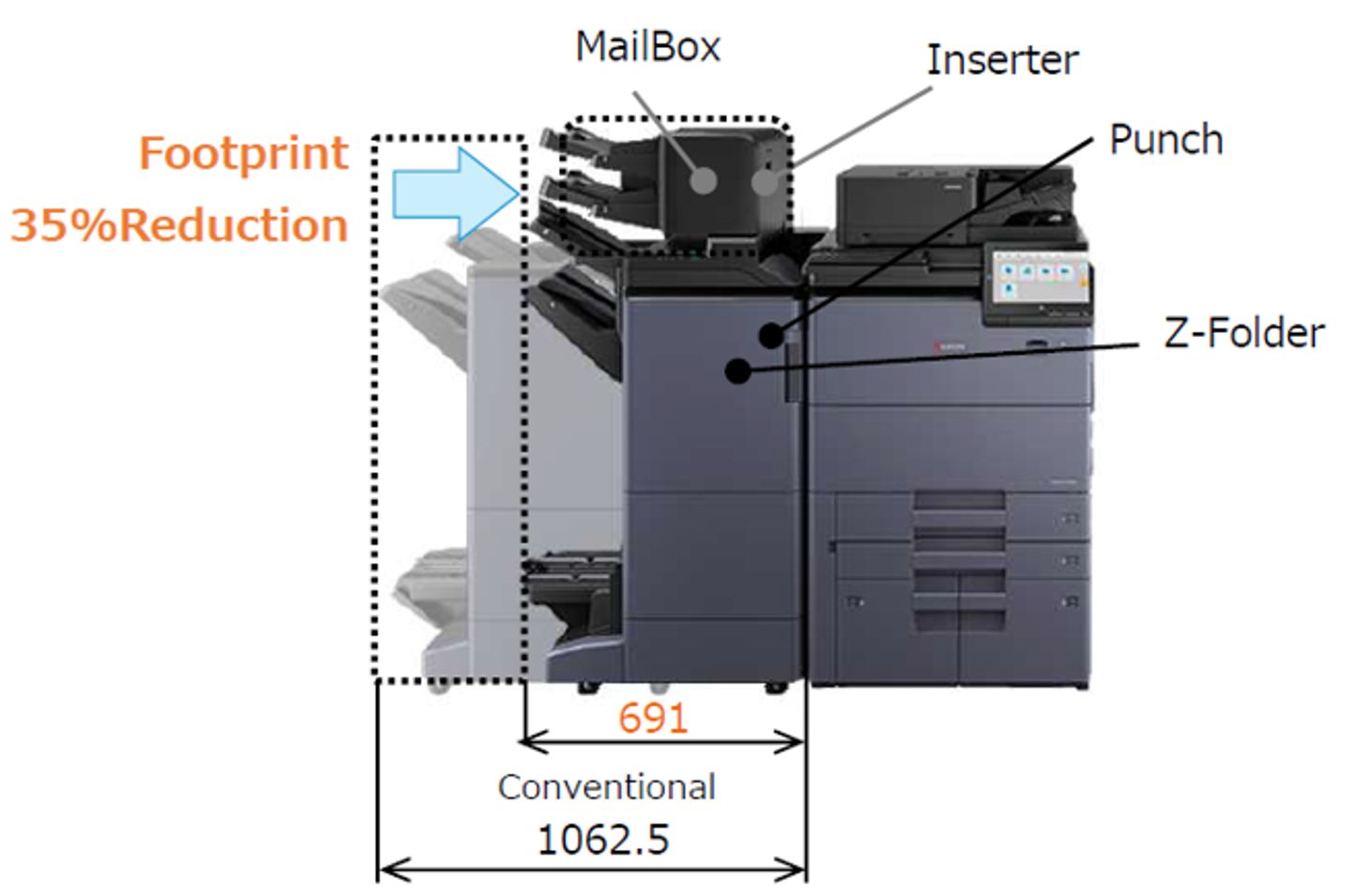
For enhancement devices fitted to the TASKalfa MZ10500 Series A3 color MFPs, optional folding units and inserters formerly placed beside the finisher were redesigned for integration inside or above the finisher.
Consolidating functions vertically reduces the overall footprint.
This reduces the installation area with all options fitted by approximately 35% compared with the previous model*6.
The design helps make effective use of office space.
*6 Compared with the DF-7150 + ZE-7100 + AK-7120 (with trays retracted)
 Airflow Inside the ECOSYS MA2600cwfx
Ozone-free
Our products use photoconductors compatible with positive charging, including a-Si photoconductor drums and PSLP*3 organic photoconductor drums.
As shown, combining a positively charged photoconductor with roller charging substantially suppresses ozone generation versus conventional charging methods, reducing ozone to an extremely low level and minimizing impact on the office environment.
We have applied this ozone-free design since 2010 as part of our efforts to create comfortable office environments with lower environmental impact.
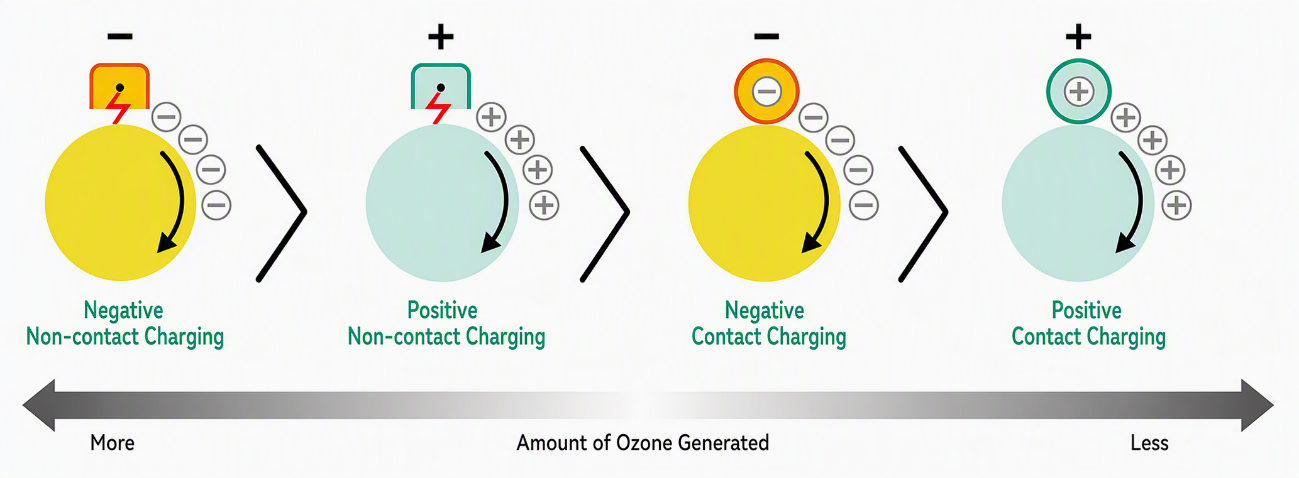 Ozone-Free Design Diagram
Life Cycle Assessment
At Kyocera Document Solutions, we conduct Life Cycle Assessments (LCA) for all products to evaluate environmental impacts across the entire product lifecycle and drive continuous improvement.
By quantitatively evaluating each stage, including raw material extraction, manufacturing, transportation, use, and end-of-life disposal and recycling, we identify high-impact processes and advance more effective environmentally conscious product design.
What is LCA?
LCA is a technique that visualizes the overall environmental impacts of a product or service by quantifying the amount of resources and energy used as well as waste generated at every stage of the life cycle of the product or service, from raw material extraction through manufacture, distribution, use, and disposal/recycling. This visualization of environmental impact in terms of climate change, depletion of natural resources, etc. enables us to make an objective evaluation of the effectiveness of our environmental action plans and achievements. The International Organization for Standardization (ISO) provides quantitative assessment methods for LCA under ISO14040 and ISO14044, while ISO 14025 covers environmental declaration procedures. Our products are authorized to bear the EcoLeaf environmental label, which is the only ISO Type III environmental label based on LCA in Japan. After developing our own data collection system for conducting LCAs and acquiring EcoLeaf system certification, we are now able to conduct LCAs on an ongoing basis and release information on EcoLeaf-certified products to the public in a timely manner.
Life Cycle Stages

Benefits of LCA
LCAs have the following benefits.
| 1. | Quantification of environmental impact enables us to choose optimal environmental solutions from multiple options. |
| 2. | Visualization of environmental impact at each stage of a product's life cycle enables us to see the areas where environmental impact is reduced most effectively. |
| 3. | Assessment of environmental impact at each stage enables us to prevent problems from occurring or affecting other stages. |
| 4. | Quantification of environmental measures and their effectiveness gives us scientific and objective grounds for making decisions on environmental policies. |
| 5. | The ability to publish LCA data on our website when a product is introduced into the market ensures the timely disclosure of environmental information. |
Reducing Environmental Impact at Every Stage via LCA
| Category | Previous model | New model |
|---|---|---|
| Color A3 MFP TASKalfa 4052ci | Color A3 MFP TASKalfa 4053ci | |
| Printing speed (number of pages per minute) | Monochrome 40 Color 40 | Monochrome 40 Color 40 |
| Weight (kg) | 95 | 95 |
| Number of pages that can be printed over its lifetime | Monochrome 480,000 Color 480,000 | Monochrome 480,000 Color 480,000 |
| Release date | July 2016 | January 2019 |
Example of LCA
 評価事例
Assessment Results
Compared to its predecessor, the A3 color MFP "TASKalfa 4052ci", our new A3 color MFP "TASKalfa 4053ci" reduces the global warming impact 17% more over its entire life cycle. Most of the global warming impact from our printers comes from material manufacturing, electricity use when they are on standby or in operation, and consumable supplies such as toner. We are making various efforts to reduce the global warming impact at these stages of the product life cycle. With the TASKalfa 4053ci, we reduced global warming impact by 6% at the material manufacturing stage and by 45% in relation to consumables at the product use stage through the reduction of packaging materials.
Environmental Education for Engineers
In order to design environmentally friendly products, engineers must fully understand why environmentally friendly design is so important. We educate young engineers in the technical division on our internal chemical substance control system, the 3Rs*7, environmental labeling in countries around the world, and an overview of LCA. On top of that we provide product development personnel with practical training (including environmental labeling and requirements in countries around the world, environmentally friendly design standards, and the quantitative impact assessment techniques for LCA).
*7 The 3Rs: Reduce, Reuse, and Recycle
Education for young engineers mainly covers:
| ・ | Kyocera Document Solutions' chemical substance control system |
| ・ | The 3Rs |
| ・ | Environmental labeling in countries around the world |
| ・ | Energy conservation regulations in countries around the world |
| ・ | An overview of LCA |
Education for product development personnel mainly covers:
| ・ | Environmental labeling and requirements in countries around the world |
| ・ | Environmentally friendly design standards |
| ・ | Quantitative impact assessment techniques for LCA |
| ・ | Kyocera Document Solutions' chemical substance control system |
