
KYOCERA Document Solutions

Sustainability
Product Use Stage - Compliance with Environmental Labelling Requirements
Environmental labels help customers easily identify environmentally friendly products. Kyocera Document Solutions is committed to making environmentally friendly products and is actively working to acquire environmental label certification.
Types of Environmental Labels and Certified/Registered Products
Three types of environmental labels have been specified by the International Organization for Standardization (ISO): Type I (a voluntary third-party program that certifies products within a particular category based on an independently set environmental criteria), Type II (self-declared environmental claims made by businesses about their products based on their own criteria), and Type III (environmental labels that indicate the environmental impact of a product analyzed in a quantitative manner throughout its life cycle from resource extraction to disposal using the life cycle assessment method).
All of our products have been certified under the International Energy Star Program, an international program that promotes energy efficient office automation equipment. We design our products to meet the requirements of major environmental labels (Type I) across the globe, such as the Eco Mark and Blue Angel, right from the product development stage, and actively work to acquire certification for these labels. We are also making an all-out effort to reduce the environmental impact of our products throughout their life cycle from resource extraction to disposal. We register our products with SuMPO* EPDs, a Type III environmental label program by SuMPO, to actively disclose environmental data related to our products.
In FY 2025, the following products were certified or registered for environmental labels.
* SuMPO : Sustainable Management Promotion Organization
| Product Name | Environmental Label | |||
|---|---|---|---|---|
 Eco Mark (Japan) |  EPEAT EPEAT(USA) |  Blue Angel (Germany) | ||
| MFPs | ECOSYS MA4000wifx | 〇 | 〇 | 〇 |
| ECOSYS MA4000wfx | 〇 | 〇 | - | |
| ECOSYS MA4000fx | - | - | 〇 | |
| ECOSYS MA4000x | - | 〇 | 〇 | |
| ECOSYS MA2600cwfx | 〇 | ※ | 〇 | |
| ECOSYS MA2600cfx | - | - | 〇 | |
| ECOSYS MA2600cwx | - | ※ | - | |
| ECOSYS MA2101cwfx | - | ※ | 〇 | |
| ECOSYS MA2101cfx | - | ※ | 〇 | |
| TASKalfa MZ7001ci | 〇 | ※ | ※ | |
| TASKalfa MZ7001ciW | 〇 | - | - | |
| TASKalfa MZ4001ci | 〇 | ※ | ※ | |
| TASKalfa MZ4001ciW | 〇 | - | - | |
| TASKalfa MZ3501ci | 〇 | ※ | ※ | |
| TASKalfa MZ3501ciW | 〇 | - | - | |
| TASKalfa MZ2501ciW | 〇 | - | - | |
| TASKalfa MZ7001i | 〇 | ※ | ※ | |
| TASKalfa MZ6001i | 〇 | ※ | ※ | |
| TASKalfa MZ5001i | 〇 | ※ | ※ | |
| TASKalfa MZ4001i | - | ※ | - | |
| Printers | ECOSYS PA4000wx | 〇 | 〇 | 〇 |
| ECOSYS PA4000x | - | - | 〇 | |
| ECOSYS PA2600cwx | 〇 | ※ | 〇 | |
| ECOSYS PA2600cx | - | ※ | 〇 | |
| ECOSYS PA2101cwx | - | ※ | 〇 | |
| ECOSYS PA2101cx | - | ※ | 〇 | |
- : Not sold in countries where the label is used
※: Application for acquisition is scheduled to be submitted from April 2025 onward
Type I
Type I environmental labels are certified by third parties based on their own product categories and criteria.
- Pass/fail determinations are based on their criteria.
- The third-party organization decides product categories and criteria.
- Businesses are authorized to use a label after their applications are screened.
Eco Mark
The Eco Mark is an ecolabel established in 1989 by the Japan Environmental Association. It is displayed on products that have a low environmental impact throughout their entire life cycle, from production to disposal, and help protect the environment.

Blue Angel
The Blue Angel is the world's first ecolabelling system. It was introduced in Germany in 1978 with the aim of solving environmental problems and promoting the development and sale of environmentally friendly products. The system is overseen by the German Federal Ministry for the Environment, Nature Conservation and Nuclear Safety.

Type II
Type II environmental labels are self-declared environmental claims made by businesses about their products based on their own criteria. Unlike other environmental labels, they do not require third party certification.
Type III
Type III environmental labels indicate the environmental impact of a product analyzed in a quantitative manner throughout its life cycle from resource extraction to disposal using the life cycle assessment method.
The general rules and procedures of Type III environmental labels are stipulated in ISO 14025.
Type III environmental labels typically disclose only quantitative data about products and leave it up to the buyer to evaluate the products and interpret the data.
- It's not a pass or fail system.
- Labels indicate quantitative environmental impact data.
- It's up to the consumer to interpret the data.
SuMPO EPD Program
SuMPO EPD (Environmental Product Declaration) program is operated and managed by the Sustainable Management Promotion Organization (SuMPO) in accordance with the international standard ISO 14025. With the world’s second-longest history among EPD programs, it was launched in 2002 as the “EcoLeaf Environmental Label” and has been in operation for over 20 years. The program provides quantitative disclosure of environmental impacts across the entire lifecycle of products and services—from raw material procurement through disposal and recycling.
Other Environmental Labels
International Energy Star Program
The International Energy Star Program is an international certification program that promotes energy efficient office automation equipment. Launched in October 1995 by the U.S. Environmental Protection Agency (EPA), the program operates in partnership with Japan's Ministry of Economy, Trade and Industry in certifying Energy Star registered products. Products that meet certain criteria can be labelled with the "International Energy Star" Logo.

Act on Promoting Green Purchasing
The Act on Promotion of Procurement of Eco-Friendly Goods and Services by the State and Other Entities (Act on Promoting Green Purchasing) enacted in April 2001 requires public agencies and other organizations to purchase products and services that have low environmental impact. We label our products that comply with the criteria for eco-friendly goods specified by the Act on Promoting Green Purchasing with the Kyocera Group's own conformity mark in catalogs and on our websites so that customers can use it as a guide when making purchase decisions.

EPEAT*
EPEAT is a registry program started in the U.S. in 2006 for evaluating the effect of electronic products on the environment. In 2013, MFPs and printers were added to the range of products it covers. Products are evaluated on the basis of 23 required criteria and 28 optional criteria and rated Bronze, Silver or Gold depending on how many of the criteria they meet. Today EPEAT is used as a procurement requirement by national and local government organizations in the US and many other countries as well as universities and companies.

* Electronic Product Environmental Assessment Tool
Measuring Emissions at ISO/IEC 17025 Accredited Laboratory
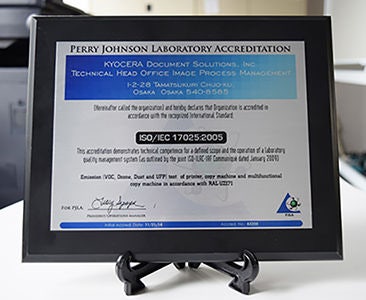
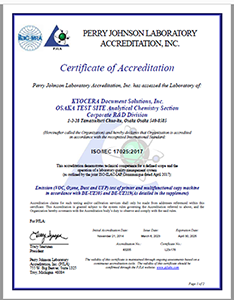
ISO/IEC 17025 is an international standard for testing and calibration processes used to obtain official test results on the characteristics and properties of products, their mechanical parts, materials and raw materials.
The Global Headquarters became certified for the standard in November 2014 and has the in-house capability to obtain emissions data required for environmental labels of various countries, including the Blue Angel, and apply for environmental labels with accreditation organizations. We closely examine the data and use it for product development to quickly deliver products with outstanding environmental performance to the market.
 ISO/IEC 17025 Plaque
 ISO/IEC 17025 Certification
