
KYOCERA Document Solutions

Sustainability
Recycling Activities
We contribute to the goal of sustainable resource recycling by purchasing materials and supply that have lower environmental impact, reducing new resource consumption, and minimizing waste.
Approaches to the Circular Economy
From Long-Life Design to Reuse: Refurbished Products Supporting a Circular Economy
Through our long-life design philosophy, products are able to remain in use for extended periods. At the end of their initial service life, products are collected, thoroughly inspected and refurbished, and then given a second life as a manufacturer-certified refurbished products.
This initiative contributes to the efficient use of resources and waste reduction by extending product lifecycles. It also helps to reduce resource consumption and CO₂ emissions associated with the manufacturing of new products.

The long-life design of ECOSYS products enables them to maintain their value over an extended period, supporting the quality and reliability of our refurbished products. Manufacturer-certified refurbished products are identified with a dedicated label and managed in accordance with our established quality standards.
Environmental-load Reduction for Packaging Materials
The Kyocera Group promotes the reduction of material use and utilization of recycled resources through the design and development of packaging materials.
Recycling Waste PET Film into Product Parts
Waste PET film generated during the production process of ceramic products has been difficult to reuse due to attached substances in the process, so it has traditionally been incinerated (thermal recycling), which posed a challenge of large CO2 emissions. To address this challenge, we were the first in the industry to establish technology*1 to convert waste PET film into recycled PET material and upcycle it (reuse for higher-value applications) into parts for MFPs and printers.
Rather than relying on incineration, by collecting and reusing these materials to create new products, we reduce waste and CO₂ emissions while also reducing the use of new plastic.
This is an excellent example of resource circulation within the Group, and we are advancing initiatives aiming to expand to exterior parts and increase the proportion of recycled materials in the future.
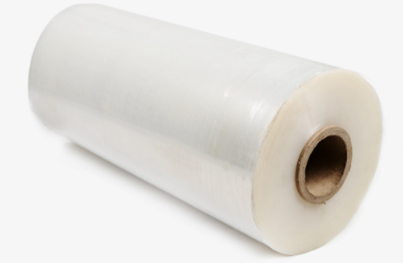 PET Film (Image)
*1 As of September 30, 2024
Circular System for MFPs and Printers
We have established a consistent circular system that spans from product design to collection and recycling.
● Environmentally Conscious Designs
The Kyocera Group has implemented long-life designs, 3R (reduce, reuse, recycle) designs, and low energy-consumption designs, and has strived to reduce environmental load since the initial stage of product development in accordance with the Environmentally Conscious Design Standards.
● Post-consumer Recycled (PCR*2) Plastic Utilization
The Kyocera Group has implemented PCR for products and toner containers. The Group set the goal of 1% or more PCR utilization in 2023, 5% or more PCR utilization and the use of recycled materials at 50% of all MFPs in 2024.
*2 PCR : Plastic raw materials made from plastics discarded after consumer use.
● From Collection to Reuse
We collect used MFPs and printers and promote their reuse at both the material and product levels in selected regions. By enhancing designs that facilitate easier refurbishment, we aim to expand reuse across our product portfolio.
