
KYOCERA Document Solutions

Sustainability
Measures to Fight Climate Change
The Financial Stability Board's Task Force on Climate-Related Financial Disclosures (TCFD) asks all companies to assess climate-related risks and opportunities using climate change scenarios and disclose them in their business strategies and risk management. The Kyocera Group endorses the TCFD recommendations and has established a governance system that implements risk management and business strategies and sets metrics and targets as part of efforts to promote these initiatives.
The Kyocera Group also recognizes climate change mitigation as an important issue, and in 2018, the Kyocera Group sets a long-term environmental goal of achieving a 2°C level. In 2021, the Kyocera Group updated its long-term environmental goal to a 1.5°C level and aim to reduce Scope 1, 2, 3 emissions by 46% compared to FY 2020 levels by FY 2031, with the ultimate goal of achieving carbon neutrality by FY 2051.
To achieve its long-term environmental goal, the Kyocera Group actively implements renewable energy and energy-saving measures at each of its locations. The Kyocera Group is committed to various measures to prevent global warming.
Goal and Result of CO₂ emissions in Scope 1,2 for the whole group for the FY 2025
| Goal for FY 2025 | Result for FY 2025 | |
|---|---|---|
| CO2 Emission*1 | 53,545 | 25,259 |
Goal of CO₂ emissions in Scope 1,2 for the whole group for the FY 2026
| Goal for FY 2026 | |
|---|---|
| CO2 Emissions*1 | 27,562 |
*1 Boundary of the Report: KYOCERA Document Solutions Global Headquarters, Hirakata Plant, Tamaki Plant, Minatomirai Research Center, KYOCERA Document Solutions Japan, China Plant, and Vietnam Plant
Energy Consumption at Each Production Site
New Renewable Energy Options
To expand the use of electricity generated from renewable energy sources, we have been installing solar power generation systems at our business sites and plants all over the world. In January 2025, additional solar power generation systems were installed at the Hirakata Plant and the Tamaki Plant. As a result, these two plants are expected to generate approximately 1.9 GWh of electricity annually, covering about 11% of their total electricity consumption. This initiative is projected to reduce CO₂ emissions by approximately 860 metric tons per year, equivalent to the carbon absorption of about 61,714 trees.
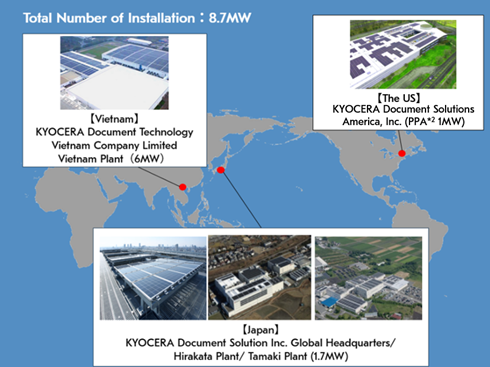 Solar Power Installation
*2 Power Purchase Agreement concluded between a power generator and a specific customer
