
KYOCERA Document Solutions

Sustainability
Biodiversity Conservation
Respecting Biodiversity
Our lives and livelihoods are supported by the various gifts that biodiversity brings. In order to continuously enjoy these gifts, we must look into how our business activities affect biodiversity and eliminate any negative impact arising from our business activities.
At Kyocera Document Solutions the concept of "Living Together" lies at the heart of everything we do. In 2012 we incorporated Biodiversity conservation activities into our environmental management system and conduct biodiversity risk surveys at the Global Headquarters, Hirakata Plant, and Tamaki Plant. And we systematically make improvements.
In addition to addressing green purchasing, we use Kyocera Document Solutions Supply-Chain CSR Procurement Guideline and the Kyocera Document Solutions Supply-Chain CSR Deployment Check Sheet encouraging our suppliers to think about biodiversity and look for ways they can conserve it.
There are ongoing efforts to mitigate potential risks to biodiversity, such as eradicating invasive alien species earmarked as being potentially harmful.
Excerpt from biodiversity Conservation-related requirements included in the Supply-Chain CSR Procurement Guidelines
Biodiversity
Our lives and livelihoods are enriched by the various gifts that biodiversity brings. In order to continuously enjoy these gifts, participating companies must look into how their business activities affect biodiversity and eliminate any negative impact arising from such activities. We should make efforts to procure raw materials without destroying wildlife habitats, avoid using natural biological resources excessively and not transport or spread non-native species during transportation. In our business activities, we should think about the impact on human health and all living organisms, always considering water intake, wastewater discharge, exhaust air, waste, noise, vibration, and light, which may directly impact ecosystems. Ultimately, environmental management systems should reduce the overall impact on biodiversity. We should also take into account ways to reduce the negative impacts on biodiversity by maintaining the greenery on the premises of business sites, utilizing rainwater as much as possible, and preventing contamination from discharged water.
Goal and Achievement for FY 2025
| Goal for FY 2025 | Achievement for FY 2025 |
|---|---|
| Performing 6 new biodiversity protection activities | Performed 6 biodiversity protection activities |
Goal for FY 2026
| Goal for FY 2026 |
|---|
| Performing 6 new biodiversity protection activities |
* Scope of coverage: KYOCERA Document Solutions Global Headquarters / Hirakata Plant / Tamaki Plant, KYOCERA Document Solutions Japan, China Plant, Vietnam Plant
Activities
Conducting Bee Conservation Activities
Our sales companies in Germany and the United Kingdom are engaged in initiatives to protect bee habitats as part of their contribution to ecosystem conservation.
In recent years, the United Nations Food and Agriculture Organization (FAO) has highlighted concerns that the decline of pollinators, such as bees and birds that play a vital role in pollination, may affect the growth of major crops worldwide and pose risks to global food production. Our initiatives are designed to address these challenges by utilizing urban areas and business premises as habitats for pollinators, thereby contributing to the conservation of local biodiversity.
Our Germany Sales Company collaborates with an environmental conservation organization, “Beefuture,” which is dedicated to protecting bee habitats. Beehives have been installed on the company’s premises, and the initiative is operated sustainably with guidance from beekeeping specialists. Similarly, our United Kingdom Sales Company has installed beehives on the rooftop of its head office and, in cooperation with local beekeepers, is nurturing approximately 100,000 bees, thereby helping to maintain local pollination services.
These activities go beyond simply installing beehives and are implemented as comprehensive initiatives that include the development of floral resources in the surrounding environment as well as awareness-raising activities for employees and local communities. Going forward, each site will continue to maintain and expand its beekeeping activities while contributing to the creation of a sustainable local environment through measures such as addressing invasive species, reducing the impact of pesticides, and promoting green space development in collaboration with local communities.
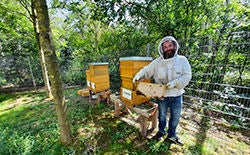 Bee conservation activity at our sales company in Germany
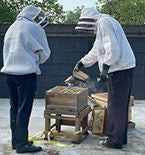 Bee conservation activity at our sales company in United Kingdom
Conducting Cleanup Activities Aimed at Preserving Marine Ecosystem
At the Vietnam Plant, an annual beach cleanup activity is conducted at Do Son Beach, located approximately 30 km from the plant, with the aim of preserving the marine ecosystem.
Amid growing global concerns over marine pollution caused by plastic waste, this initiative is carried out to raise environmental awareness in the local community and to improve the coastal environment. Each time, more than 100 employees participate in the activity, collecting plastic debris and household waste that has washed ashore. The collected waste is properly sorted and processed in cooperation with local authorities and environmental organizations. To ensure the safety of participants, safety briefings are provided in advance and protective equipment is distributed prior to the activity. Through the collection of marine debris, the initiative contributes to local environmental conservation while also enhancing environmental awareness among participating employees and fostering teamwork. The Vietnam Plant will continue to carry out this activity on an ongoing basis and strengthen collaboration with local communities as part of its commitment to the preservation of a sustainable marine environment.
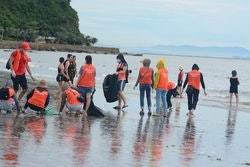 Employees conducting cleanup activity at Do Son Beach
 Participants in the cleanup activity
Participating in Yodo River Biodiversity Conservation Activities
The Global Headquarters and the Hirakata Plant participate in nature restoration activities conducted in the Yodo River basin in Osaka Prefecture, contributing to the conservation of biodiversity.
These activities are organized by Itasen Net, a network organization that brings together citizen groups, research institutions, and government agencies. The initiative aims to protect the Itasenpara bitterling, a nationally designated Natural Monument and an endangered species, as well as its habitat in the Yodo River wando (river embayment areas). Employees take part in on-site activities such as cleaning riverbanks and removing invasive animal and plant species.
Following the activities, staff members from Itasen Net provide explanations on the ecosystem of the Yodo River basin and the significance of biodiversity conservation efforts. Through both hands-on work and learning opportunities, employees deepen their environmental awareness and understanding of local environmental conservation. Through these initiatives, we contribute to the maintenance of biodiversity along riverbanks and to measures against invasive species, and will continue to promote sustainable environmental conservation activities in collaboration with local communities.
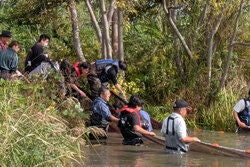 Participants conducting conservation activity
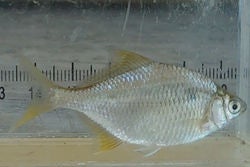 Itasenpara
Supporting “Biotope Tours” to Help Children Learn About Nature
The Tamaki Plant has entered into an agreement with the environmental conservation group “Sugashi Uda-Sada Offshore Environmental Conservation Association” to promote the conservation and restoration of satoyama and satoumi landscapes, and is engaged in biotope restoration activities. As part of these efforts, activities such as weeding and thinning, planting vegetation, and improving waterways have been carried out on land that was formerly used as rice paddies. As a result, the presence of rare flora and fauna has been confirmed. These initiatives also contribute to the conservation of wetlands and surrounding environments, as well as to improvements in soil and water resources, thereby supporting the maintenance and enhancement of local ecosystems.
In parallel with biotope restoration, the Tamaki Plant supports nature observation programs that allow children to learn about the natural environment. To ensure both educational effectiveness and safety, we provide on-site explanations, observation equipment, and advance safety guidance. Going forward, we will continue to collaborate with local organizations and schools to conduct regular conservation activities, implement long-term management plans, and share survey results, with the aim of promoting community-based satoyama restoration and providing ongoing nature education for future generations.
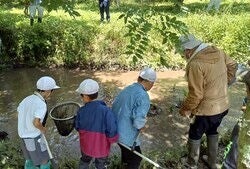 Biotope Tours
Implementing Tree-Planting Activities
At the Vietnam Plant, native Vietnamese Sao trees have been planted on its premises.
The Sao tree is an evergreen species that grows to a height of approximately 5 to 10 meters and is valued for its attractive foliage and highly durable timber. It is also commonly used as a street tree.
This tree-planting initiative is aimed at enhancing the landscape and creating a greener environment within the plant site. After planting, appropriate maintenance activities such as regular watering, pruning, and pest control are carried out. These efforts are expected to contribute to environmental benefits including the conservation of surrounding biodiversity, prevention of soil erosion, creation of shaded areas, and absorption of carbon dioxide.
Going forward, we will continue proper maintenance and management of the trees, thereby contributing to local greening efforts and the creation of a sustainable environment.
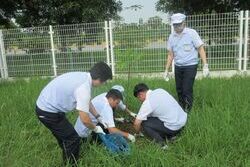 Planting Sau Trees
