
KYOCERA Document Solutions

Sustainability
Environmental Safety Policy / Targets and Promotion System
The management philosophy of LIVING TOGETHER established by our founder Kazuo Inamori, particularly the concept of coexistence with nature, aligns with the directions society is headingーcarbon neutrality, circular economy, and nature positiveーand has been passed down as the fundamental philosophy of the Kyocera Group' s sustainability efforts and the foundation of our environmental management. In 1991, we established the Kyocera Environmental Charter as our basic environmental philosophy. In 2015, considering the adoption of the Sustainable Development Goals (SDGs) and the Paris Agreement on greenhouse gas emission reduction, we established the Kyocera Group Environmental Safety Policy with the goal of contributing to the realization of a sustainable society. Based on this policy, we set targets for reducing environmental impact and promote more proactive and continuous environmental protection activities, while regularly disclosing information in accordance with disclosure standards such as the TCFD (Task Force on Climate-related Financial Disclosures) recommendations. The Kyocera Group recognizes coexistence with nature as a major materiality theme, and we have identified the following three items as priority issues to focus on resolving.
Kyocera Group Environmental Safety Policy
To promote environmental safety based on the Kyocera management philosophy, we developed the "Kyocera Group Environmental Safety Policy," which covers product development, procurement, manufacturing, distribution, sales, customer maintenance, resource recovery and reuse, to disposal. The policy, which aims to integrate environmental safety and health policies. In line with this policy, we promote more active and continuous environmental protection activities by setting goals and objectives to reduce our environmental impact, and regularly disclose such information in line with international information disclosure standards such as TCFD recommendations. Also it covers business expansion activities such as M&A, and due diligence is used to identify potential environmental risks and reflect them in post-acquisition improvement plans.
Kyocera Group Environmental Safety Policy
Based on Kyocera's founding company motto, "Respect the Divine and Love People," we established our management rationale "To provide opportunities for the material and intellectual growth of all our employees, and through our joint efforts, contribute to the advancement of society and humankind." Therefore, in addition to complying with laws and regulations on environmental safety, requirements agreed to by our company, and our own internal standards, we will continue to work to solve issues critical to society through communication with various stakeholders, participation in and support for social contribution activities, and by leveraging our technology and intellectual know-how.
1. Ensuring the safety and health of employees
- To create a safe and secure workplace for all employees, we will create a corporate culture in which everyone involved in our business activities is fully engaged.
- Kyocera will conduct risk assessments and reduce occupational health and safety risks by eliminating sources of danger to prevent workplace accidents and disasters.
- Kyocera strives to build a work environment where employees feel healthy, enjoy job satisfaction, and can reach their maximum potential by promoting mental and physical health.
- Kyocera will promote initiatives that take greater account of the characteristics of older adults.
2. Contribution to a sustainable society
- Kyocera will research, develop, produce, and expand products that contribute to the improvement of the global environment and products that reduce environmental impact throughout their life cycles.
- Kyocera will promote greenhouse gas emission control in our entire value chain to contribute to realizing a carbon-free society.
- Kyocera will contribute to realizing a recycling-oriented society by using resources more efficiently.
- Kyocera will strive to prevent environmental pollution by properly managing chemical substances in all processes.
- Kyocera will advance biodiversity conservation by minimizing the negative impact of our business activities on the natural environment and by protecting and nurturing the natural environment.
3. Operation of an environmental and safety management system
- During our business activities, through the operation of our management system, the Kyocera Group will proactively promote comprehensive measures for environmental protection and work safety, based on the management rationale, and continuously improve environmental and safety performance.
April 1, 2026
Kyocera Corporation
Shiro Sakushima, President
Long-term Environmental Targets
In 2016, the Paris Agreement came into effect, and nations and companies are working to reduce greenhouse gas emissions. The Kyocera Group also considers climate change measures to be an important issue. In 2018, we set a long-term environmental target (2°C level: 30% reduction in GHG emissions in FY2031 compared to FY2014) and received SBT certification in 2019. Subsequently, we updated the target in 2021 to 1.5°C level (46% reduction in FY2031 compared to FY2020, equivalent to 56% reduction in FY2031 compared to FY2014) and received SBT certification in May 2022.
Looking at the implementation of renewable energy, we have achieved 20 times more than that of in FY2014, a goal that was set as one of our long-term environmental targets, ahead of schedule in FY2025. Moving forward, we will set a new target, "Share of Electricity from Renewable Energy Resources: RE60 by FY2031," and continue efforts in our domestic and international activities.
Kyocera Group Long-term Environmental Targets
- Scope 1, 2*1 GHG emissions (1.5°C level) : Reduce 46% by FY 2031 compared to FY 2020 levels
- Scope 1, 2*1, 3*2 GHG emissions (1.5°C level) : Reduce 46% by FY 2031 compared to FY 2020 levels
- Share of Electricity from Renewable Energy Resources : RE60 by FY2031
- Carbon neutral by FY 2051
*1 Scope 1: Direct emission associated with fuel consumption and production processes
Scope 2: Indirect emission associated with consumption of power or heat purchased from outside
Scope 3: Indirect emission other than Scope 1 or 2 (Including procurement of raw materials, transport, use and disposal of products, as well as employee commuting and business trips)
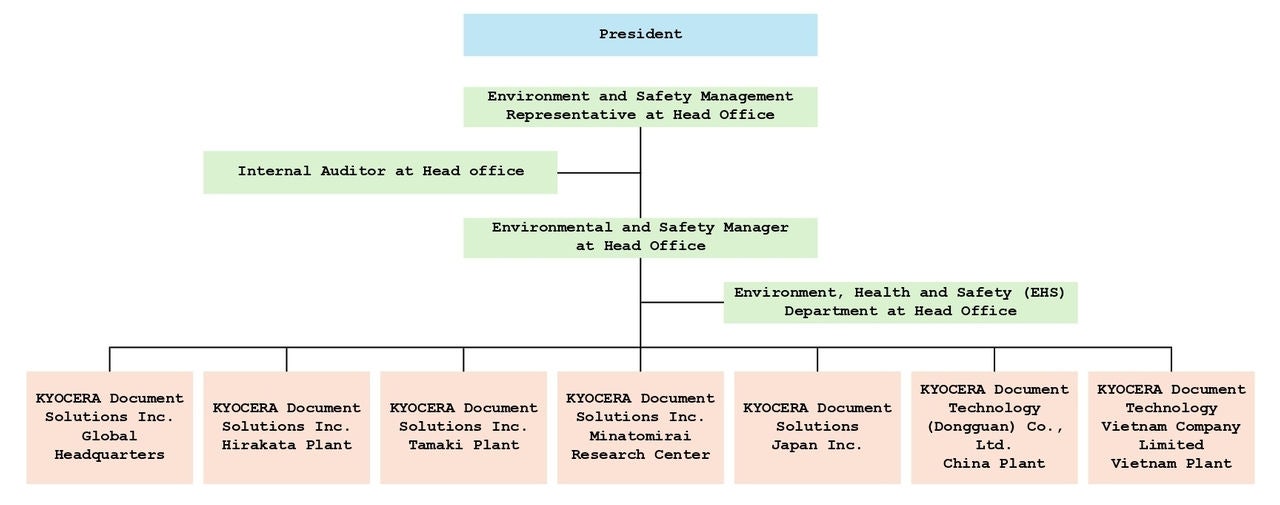 環境推進体制図
ISO 14001 Certification
Integrated Certification
EMS 635470 / ISO 14001
| Integrated Certification | |
|---|---|
| In Japan | KYOCERA Document Solutions Inc. Global Headquarters |
| KYOCERA Document Solutions Japan Inc. (Osaka headquarters) | |
| KYOCERA Document Solutions Inc. Tamaki Plant | |
| KYOCERA Document Solutions Inc. Hirakata Plant | |
| Outside of Japan | KYOCERA Document Technology (Dongguan) Co., Ltd. China Plant |
| KYOCERA Document Technology Vietnam Company Limited Vietnam Plant | |
| Individual Certification | |
| Production-related facilities | KYOCERA Document Technology Hong Kong |
| North America and Central /South America sales offices | KYOCERA Document Solutions Canada |
| Europe and Africa sales offices | KYOCERA Document Solutions Europe Management (Netherlands) |
| KYOCERA Document Solutions Deutschland | |
| KYOCERA Document Solutions United Kingdom | |
| KYOCERA Document Solutions France | |
| KYOCERA Document Solutions Italia | |
| KYOCERA Document Solutions Nederland | |
| KYOCERA Document Solutions Belgium | |
| KYOCERA Document Solutions Espana | |
| KYOCERA Document Solutions Portugal | |
| KYOCERA Document Solutions Austria | |
| KYOCERA Document Solutions South Africa | |
| KYOCERA Document Solutions Nordic | |
| KYOCERA Document Solutions Finland | |
| KYOCERA Document Solutions Danmark | |
| Asia and Oceania sales offices | KYOCERA Document Solutions Asia (Hong Kong) |
| KYOCERA Document Solutions Korea | |
| KYOCERA Document Solutions Taiwan | |
| KYOCERA Document Solutions Thailand | |
| KYOCERA Document Solutions Singapore | |
| KYOCERA Document Solutions India | |
| Headquarters supervision | KYOCERA Document Solutions Australia |
| KYOCERA Document Solutions China | |
| Group companies | TA Triumph-Adler |
| Annodata | |
Environmental and Safety Audit
To ensure compliance with environmental and safety-related laws and regulations and to verify the effectiveness of its environmental management system and occupational safety and health management system, we appoint auditors from among internally certified personnel and conducts internal environmental and safety audits annually.
In addition, the Corporate Environmental and Safety Manager conducts environmental and safety inspections at the sites in Japan as well as production and logistics sites outside of Japan. These inspections assess the management status of environmental facilities, production sites, waste storage areas, and chemical substance storage areas, thereby strengthening environmental conservation efforts.
Environmental and Safety Training
To ensure the proper implementation and maintenance of the Environmental Safety Management System(ESMS), we conduct environmental safety education, training, and awareness activities in accordance with the “Environmental Safety Education and Training Standards.”
| Type | Description |
|---|---|
| Recognition Education | We provide education and training to regular employees, mid-career hires, and employees who have been transferred to ensure that they possess the necessary awareness and competence required at business sites and plants. We also conduct environmental and safety awareness activities, such as the display of posters and educational programs during Environmental Month and Safety and Disaster Prevention Month. (Some examples of education and training topics) - Environmental and safety policies and objectives - Significant environmental aspects related to job duties, as well as actual or potential environmental impacts - Hazards and safety risks related to job duties - Compliance obligations and requirements of the ESMS - Procedures for evacuation from work situations that are considered to pose an imminent and serious danger to life or health (e.g., fire and disaster prevention drills) |
| Competence Education | We provide education and training to ensure that individuals possess the necessary competence to perform their duties. (Education and training are provided to the following personnel) - Personnel with responsibilities related to the ESMS (such as Environmental and Safety Managers, internal auditors, and compliance evaluation personnel) - Personnel who perform tasks that have the potential to cause significant environmental impacts - Personnel who perform tasks that affect or may affect occupational health and safety (OHS) performance - Personnel responsible for identifying hazards |
| Mandatory Special Education | Individuals who perform the following tasks as stipulated under the Occupational Safety and Health Act are required to obtain or complete the necessary qualifications and training (licenses, skill-based training, and mandatory special training). We ensure that appropriately qualified personnel are assigned to these positions. (Examples of applicable tasks) - Crane and forklift operation - Rigging operations - Qualified work supervisors (e.g., for organic solvents, drying equipment, bulk handling operations) |
| Induction training and training at the time of job changes | We provide induction training and training at the time of job changes to newly hired regular and mid-career employees and transferred employees prior to the commencement of work and whenever job duties are changed. |
| Line Supervisor Education | We provide safety and health education to newly appointed line supervisors and other personnel who directly instruct or supervise workers during operations, excluding designated work supervisors. |
